Source of the article:Company Trends 发布时间:2026/10/29
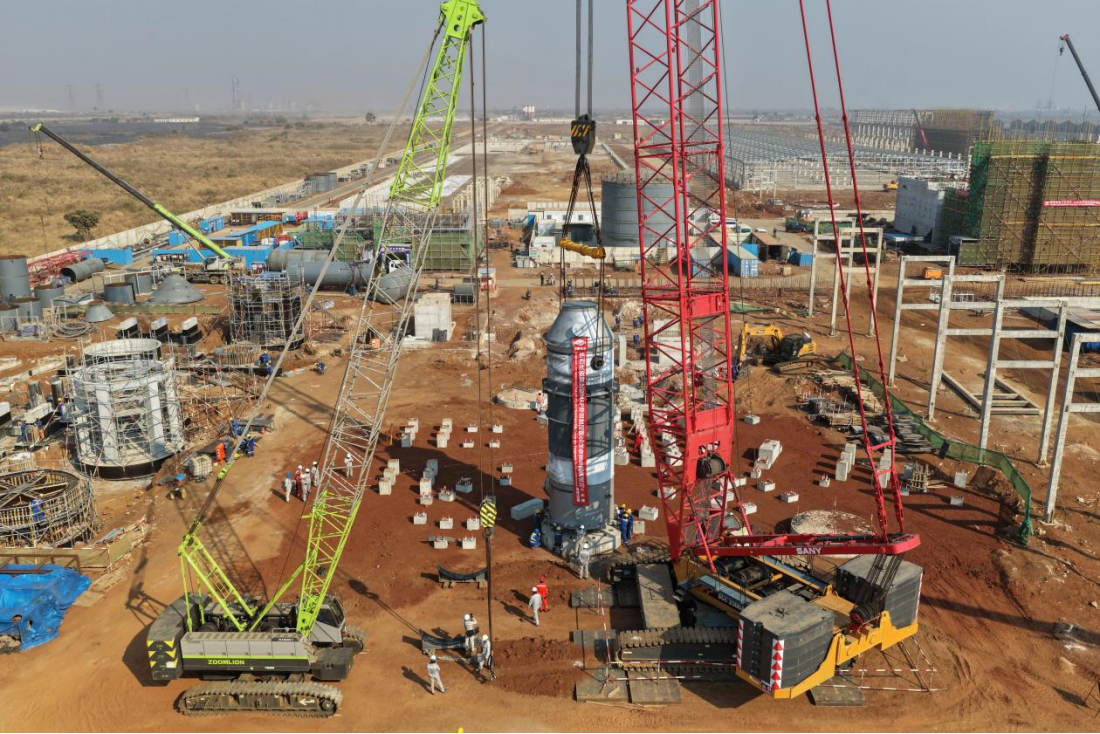
In October, the Sixth Branch of China National Chemical Engineering Sixth Construction Co., Ltd. (CC6) successfully completed the first lift of a major piece of critical equipment at the Zambia 300KTPA monoammonium phosphate (MAP) project. The heat exchanger, weighing 84 tonnes, was lifted and positioned in a single operation. This milestone marks the official commencement of heavy equipment installation and signals the project’s smooth transition into the main equipment installation phase, laying a solid foundation for achieving subsequent construction milestones across the project.
The 84-tonne heat exchanger is a key piece of process equipment. The lifting operation employed an established method using a 350-tonne crawler crane as the main lifting crane and an 85-tonne auxiliary crane for tailing and turning the equipment. Before the lift, the project team worked closely with the supervision contractor to conduct multiple reviews of the specialized lifting plan, load calculations, lifting path simulations, and risk assessments. Job Hazard Analysis (JHA) procedures and dedicated safety controls for high-risk construction works were strictly implemented.
Throughout the operation, all personnel involved adhered to safety procedures and maintained strict control over installation accuracy. The entire sequence—from turning the equipment upright and lifting it steadily to rotating it in mid-air, precisely leveling it, and completing final positioning and alignment—was carried out smoothly, accurately, and efficiently. The first heavy equipment lift was completed successfully in a single operation, with no safety hazards, positioning deviations, or operational errors reported throughout the process.
The successful lift has cleared a critical bottleneck in the installation of the project’s main process equipment, paving the way for the subsequent large-scale installation of towers, vessels, and other process equipment, as well as integrated system commissioning.
Located in the Kafue on the outskirts of Lusaka, Zambia, the project is a key initiative under China-Africa industrial capacity cooperation within the framework of the Belt and Road Initiative. It is also a major fertilizer industry project for Zambia. The project’s principal product, monoammonium phosphate (MAP), is a high-efficiency compound fertilizer for agricultural use. The project is expected to help address the shortfall in Zambia’s domestic phosphate fertilizer production capacity, reduce local agricultural production costs, and create employment opportunities while increasing local incomes.