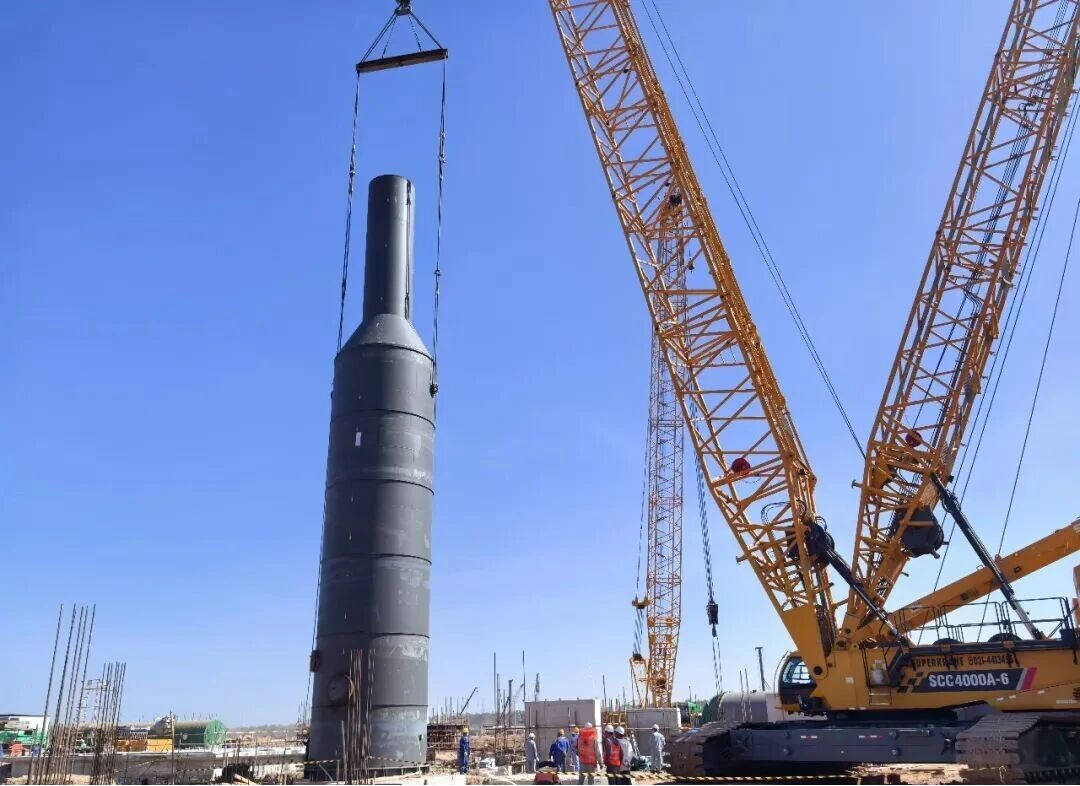
In August, the first major static equipment unit of the Indonesia Hangyang Huayou 260,000 Nm³/h Air Separation Project, undertaken by the First Branch of China National Chemical Engineering Sixth Construction Co., Ltd. (CC6), was successfully lifted into position. The equipment, a cooling tower standing 27 meters tall and weighing 45 tonnes, marks the start of a major phase of heavy equipment installation.
The project is located in the Indonesia Pomalaa Industrial Park (IPIP) in Pomalaa Town, Kolaka Regency, Southeast Sulawesi Province, Indonesia, and involves the planned construction of four large-scale air separation units. Once completed and commissioned, the project will provide a reliable and continuous supply of industrial gases to the industrial park. As a key supporting utility facility for the regional pyrometallurgical smelting industry, it will help ensure the stable operation of local metallurgical production.
As a core cooling component of the air separation unit, the cooling tower’s tall, slender vertical structure required precise control throughout the lifting operation. The project team used CNCEC’s integrated smart construction site lifting software to simulate the entire lifting process. Actual site measurements were incorporated into repeated calculations of lifting-point loads and wind-load effects. The operation employed a 400-ton crawler crane for the main lift and a 150-ton crane for tailing. The entire sequence—from lifting and raising the tower to alignment and temporary securing—was completed in just 20 minutes, achieving precise positioning on the first attempt.
The project site has a tropical rainforest climate characterized by high temperatures, heavy rainfall, and high humidity. To address these conditions, the project team developed an off-peak construction schedule, erected rain- and dust-protection shelters for large equipment, and applied protective pretreatment to metal components. Core equipment was prefabricated in modules in China and transported to the industrial park in Indonesia aboard a roll-on/roll-off vessel, reducing on-site welding work by more than 60%.
The team also implemented a dual-layer management model combining Chinese technical specialists with locally recruited workers. Local employees received three months of specialized skills training, while a translation team providing Chinese, English, and Indonesian language support ensured that instructions were communicated accurately.
During subsequent installation activities, the project team will continue to leverage CC6’s strengths in overseas project delivery, modular integrated construction, and localized service support. Through meticulous control at every stage, the team aims to deliver a high-quality project, contribute to the development of an overseas demonstration platform for “Intelligent Manufacturing in China,” and further strengthen friendly cooperation between China and Indonesia.